Why We’re Building a Free e-Signature Tool
As someone who has always enjoyed “building the solution” the biggest constraints I’ve always faced have been time & budget. There’s only so much time for me to build software, so I’ve often been forced to pay for and work with software tools I don’t like because I “just don’t have the time right now” to build a better solution.
In this age of AI, those constraints are fading. Much of the software I’ve been paying for over the years can now be replaced (nearly) for free. We just recently cancelled our HubSpot auto-renew. We’re now in the process of cancelling our Adobe subscription.
It wasn’t one decision, but a slow erosion. GIMP replaced Photoshop for what I need. Descript replaced Premiere Pro. Each one made the bundle harder to justify. But there was one piece I couldn’t replace easily: Acrobat. Specifically, e-signature.
Google’s DocHub handles my PDF editing, and honestly their e-signature is fine, but it lives inside their ecosystem. And that’s what stuck with me: capturing a signature is one of the simplest interactions in business, yet doing it on your own website means paying DocuSign or Adobe per envelope, forever.
Here’s the thing, everyone already owns a signing device. Your phone has a touchscreen, a camera, and a browser. That’s the complete hardware requirement for capturing a legally binding electronic signature. The ESIGN Act has recognized them for over twenty years. The technology isn’t the problem. The business model is.
So I’m building SignSeen: open-source electronic signature with a witness.
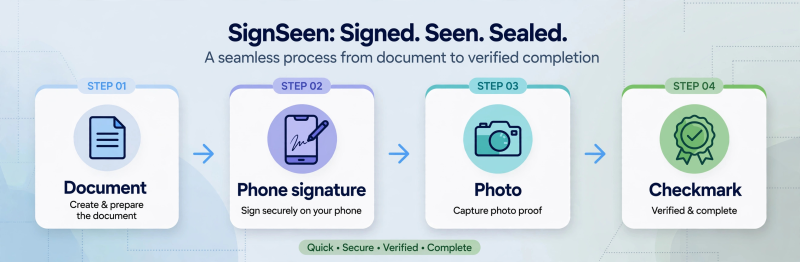
The vision: if you’re a developer, self-host it. Drop in a WordPress plugin. Add one line of JavaScript to the terms page on your SaaS. If you’re not technical, use a free hosted version we’ll provide. Either way the flow is the same: on your phone you tap to sign, on a computer you scan a QR code and sign on your phone. Draw the signature, snap a photo, done. Signed. Seen. Sealed.
The photo is the whole point. Anyone can paste a signature image onto a PDF. That’s not trust, it’s clip art. What makes a signature mean something is attribution: proof of who was holding the pen. Every SignSeen signature ships with a photographic witness, a tamper-evident audit trail, and a document hash proving nothing changed after signing. No certificates to install. No accounts to create. No per-envelope meter running.
I’m building it in public, and AI is writing the code.
I’ve built software before with the assistance of CoPilot, Claude Code, and ChatGPT Codex – and more recently with Grok, Qwen, and DeepSeek. This time around I’m attempting to build this project 95% hands off, with Muse as the AI that will be acting both as my chief of staff and providing the engineering. Muse is building SignSeen from a scope document I approved (that it helped me author). Every change arrives as a pull request. I’ll still review every line with tests gating every merge. When it works, it’s a case study in what AI-assisted development can actually do. When it breaks, you’ll watch us fix it in the open. That’s the deal with building in public, and honestly, it’s the most interesting part.
Why free? Because SignSeen is the first of several open-source projects from Origin Development aimed at the same target: replacing expensive SaaS and other business “solutions” that have been taxing small businesses (including mine) for years. Today it’s DocuSign and Adobe Sign. There’s more coming.
Signed. Seen. Sealed. Let’s go.